
Extended-range GMLRS surpasses 100km in latest US Army flight test

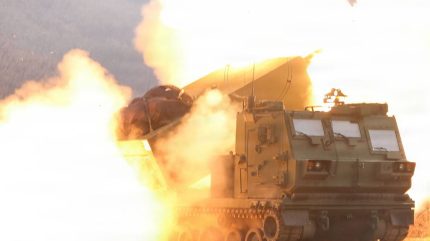
The US Army conducted a successful flight test of the Extended-Range Guided Multiple-Launch Rocket System (ER GMLRS) on 30 January at White Sands Missile Range in New Mexico.
During the test, the system engaged area targets at distances exceeding 100 kilometres (km), according to a statement from the US Army.

Discover B2B Marketing That Performs
Combine business intelligence and editorial excellence to reach engaged professionals across 36 leading media platforms.
Find out more
The test used the Alternative Warhead (AW) variant of the ER GMLRS, which was launched from a High Mobility Artillery Rocket System (HIMARS), with performance metrics reported as “meeting or exceeding expectations”.
The ER GMLRS extends the range capability to 150km, doubling that of the standard GMLRS, and allows commanders to strike high-value, time-sensitive targets from increased distances using existing HIMARS and M270A2 platforms.
This approach enables the US Army to increase strike options without procuring new launch vehicles or altering unit structures.
Portfolio Acquisition Executive Fires lieutenant general Frank Lozano said: “Extended Range GMLRS demonstrates how the Army and industry are working together to deliver meaningful capability at the pace of relevance. By building on a proven system and expanding range while maintaining precision, ER GMLRS gives commanders greater operational flexibility without introducing unnecessary complexity.”
Soldiers are scheduled to participate in further operational tests of the ER GMLRS Alternative Warhead prior to its fielding.
The ER GMLRS is designed as a GPS-guided, all-weather surface-to-surface rocket with a maximum range of 150km.
It features enhancements in manoeuvrability and attack trajectory options and incorporates a Safe and Arm Mechanism (SMPS) for optimising height-of-burst detonation for both Unitary and Alternative Warhead variants, each equipped with a 200-pound class high explosive payload.
The Unitary version creates blast fragmentation upon detonation, while the Alternative Warhead releases two layers of preformed penetrators.
Detonation options for the ER GMLRS include height-of-burst detonation above ground, point detonation upon impact, or delayed detonation after impact for the Unitary variant.
The ER GMLRS programme began in June 2017 as an engineering change proposal for both AW and Unitary rockets.
The Department of Operational Test & Evaluation approved the corresponding Test and Evaluation Master Plan annex in August 2020.
The programme has faced delays resulting from design challenges, temporary facility closures due to COVID-19 restrictions, and production line disruptions.
In October 2024, Lockheed Martin Missiles and Fire Control secured a contract worth up to $4.1bn for production of extended-range GMLRS rockets and associated hardware.
