
BAE Systems test ‘BATS’ C-UAS software next month

- BAE Systems will test its namesake Anti Threat System (BATS) for the first time in April, with live fire trials to follow in the summer
- This artificial intelligence (AI) driven command and control (C2) software was developed in just six months, beginning in October 2025
- The capability meets a global demand to employ layered counter drone hardware
BAE Systems confirmed plans to test its BATS system in April, followed by live fire trials in the summer of 2026.
Fundamentally, the UK defence prime describes the system as an AI-driven, software-defined C2 “decision engine”.

Discover B2B Marketing That Performs
Combine business intelligence and editorial excellence to reach engaged professionals across 36 leading media platforms.
Find out more
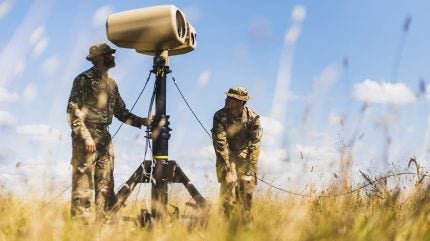
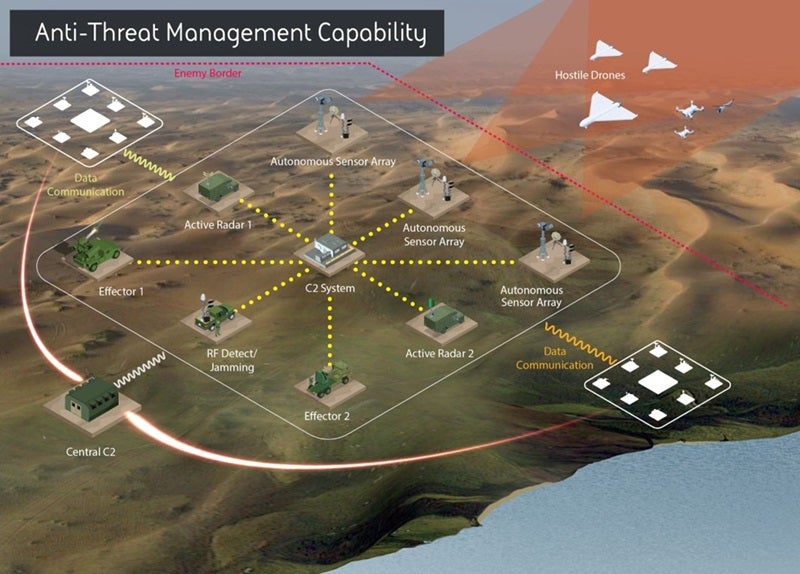
BATS has an open architecture that brings together various counter drone (C-UAS) capabilities into a unified web of sensors and effectors. The software uses rapid decision logic to recommend the most appropriate effector (missile or jammer) to defeat approaching threats.
Ultimately, BATS is designed to detect, identify and defeat uncrewed threats, most notably uncrewed aerial systems (UAS).
The drone threat is playing out with a costly impact in the Middle East. Here, Gulf nations respond to Iran’s barrage of low-cost, one-way attack Shaheds with PAC-3 missile interceptors designed to defeat large aircraft and ballistic missiles at a cost of nearly $4m per shot.
But experience from the war in Ukraine teaches that a layered air defence encompassing a number of low-cost sensors and weapons is the best model for defeating drones sustainably.
BAE Systems began developing its C-UAS central nervous system in October 2025 after an uptick of Russian-linked drone incursions across Europe, from Poland to Denmark, which brought local economies to a standstill, thus exposing the continent’s inability to respond to the threat.
But speaking with Army Technology, Louise Haywood, head of strategy at BAE’s digital intelligence business, said no single incident triggered the creation of BATS: “We acted on the broader proliferation of UAS, lessons from multiple conflicts, and conversations with users across the world.”
There was no formal UK Government tasking; the company conceived and developed BATS on its own initiative, with its own funding, “in response to market signals.”
The analytics firm GlobalData projects the global military UAS market will rapidly expand from $15bn to $28bn over the next ten years.
Notably, the company only started developing the BATS software six months ago.
When asked how the company could reach the test phase in such a short turn around, Haywood ascribed the push to an “agile team that operates a new way of working.”
One which combines high technology readiness level components into an open architecture.
“That combination let us prototype fast without compromising on safety, assurance or sovereign control,” she concluded.
BAE Systems’ offering is not the only system available, however, there are other similar AI driven C2 software products in Europe. On 18 September 2025, for example, the UK Ministry of Defence partnered with American deep tech firm Palantir to mentor British small businesses to bring AI capabilities to data analysis, intelligence, decision support and targeting systems.
Meanwhile, the British Army has also tested Anduril’s Lattice suite under Project ASGARD, which an Anduril UK representative told this reporter in mid-2025 that its capability also “connects any sensor, any effector”.
In an effort to carve out the uniqueness BATS in the growing AI driven software market, Laywood added that BAE are also developing synthetic test environments to enable cost-effective performance modelling, testing, and training.
