
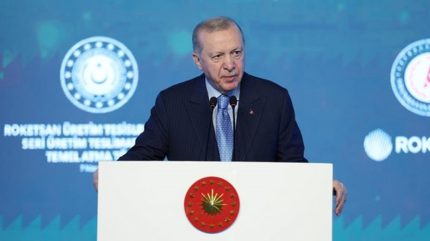
‘We rely on the strength of our own arms’ says Erdoğan

- Türkiye’s President Erdoğan attended the opening ceremony of a new munitions production facility in Ankara
- Erdoğan was quick to stress the strategic autonomy of Türkiye’s sovereign defence industry
- But recent the interception of Iranian ballistic missiles in Turkish airspace demonstrates the the nation’s close coordination with Nato’s air defence architecture
Türkiye’s President Recep Tayyip Erdoğan attended the opening ceremony of a new munitions production facility in Ankara on 7 April, where he extolled the state-run company Roketsan and accented the autonomy of the nation’s defence industry.
The site is one of many to come which, Erdoğan said, will focus on the increased manufacturing of TAYFUN, SİPER, ATMACA, HİSAR-A, HİSAR-O, and SUNGUR air defence systems, ÇAKIR and SOM cruise missiles, as well as MAM-T and MAM-L smart micro munitions.

Discover B2B Marketing That Performs
Combine business intelligence and editorial excellence to reach engaged professionals across 36 leading media platforms.
Find out more
“Today, God forbid, if something were to happen to us, we rely not on others, but first and foremost on the strength of our own arms.”
How valid are these claims?
While GlobalData market intelligence suggests that devaluation of the lira has reduced Türkiye’s purchasing power and defence imports, on which the country still relies, most recently procuring Eurofighter Typhoons from the UK last year, this economic issue has nonetheless helped the country rely more on sovereign made systems.
In his speech, Erdoğan maintained that the Government had reduced the rate of dependence on foreign sources in defence from 80 to 20% between 2004 and 2022.
Türkiye’s defence industrial base has expanded, particularly in the munitions and air defence sectors, hence Erdoğan’s praise for Roketsan, which will open new facilities including its Lalahan warhead and missile integration facilities, Kırıkkale fuel production plant and an advanced technologies R&D and engineering centre.
Iranian strikes
But amid the volatility in the Near and Middle East, brought about by the United States and Israel’s war against Iran, prompting the Islamic Republic to conduct strikes against targets across the region, Türkiye has still leaned on the support of allies to defend its territory.
The Nato alliance identified, tracked and intercepted four Iranian ballistic missiles on route to and inside Turkish airspace amid the hostilities.
On 10 March, in a phone call with Erdoğan, Iran’s President Masoud Pazeshkian insisted that the missiles that entered Turkish airspace were not of Iranian origin.
While a fragile ceasefire is currently in place, with talks set to begin between the US and Iran in Islamabad on 10 April, the Nato interception demonstrates how close a Turkish response to threats against its territory is tied with Nato’s air defence structure.
There is currently a Spanish Patriot air defence battery located in Incirlik Air Base, in Adana province, in the south of the country.
An American X-band array AN/TPY-2 radar system is deployed at Kurecik.
In March 2026, following the first three Iranian missile strikes, Reuters reported that the Turkish Ministry of Defence announced the planned deployment of another Patriot air defence system to the country to be based in Malatya.
During a round table meeting on Nato-Türkiye relations in Paris on 12 March, associate professor, Dr Murat Aslan, faculty member at Hasan Kalyoncu University, an institution located in Gaziantep, an area where one of the ballistic missiles was downed, argued:
“Nato’s support for Türkiye in this war is crucial not only to support Türkiye but also to test how prepared the alliance is.”
