

AUSA 2025: Rafael unveil L-Spike 4X loitering missile

Rafael USA presented the latest variant in its enduring Spike missile family for the first time at AUSA in Washington DC this week.
Known as the L-Spike 4X Launched Effect, the weapon is named to delineate its 40km range from the extant Spike non-line-of-sight (NLOS) missile at 32km, and to further contrast from the range of two future Spike missile concepts that are currently in development, a programme officer at Rafael told Army Technology on the show floor on 14 October.
Ultimately, the capability functions as a ‘loitering missile’ in contrast to a standard uncrewed aerial system (UAS) or drone.
Notably, the difference between these two types of launched effect comes down to speed as the loitering missile is powered by a propellent instead of electric propulsion, meaning the warhead can reach its target much quicker than a UAS carrying a warhead.
Furthermore, the ‘loitering’ phase comes five minutes after the the missile is launched, whereupon the weapon is able to fly around autonomously for a further 25 minutes.
At this stage, in loitering mode, the missile can map out the battlefield and identifying targets using an artificial intelligence tool known as automatic target recognition (ATR), which combines television and an infrared camera in its seeker. The information is then relayed back to the operator.
The Rafael spokesperson continued to note that the L-Spike 4X is designed to be launched from an existing launcher that is widely used for the Spike NLOS missile in service among 19 Nato countries and others, including the US Army, which recently selected the weapon to be used from ground vehicles among its infantry brigade combat teams.
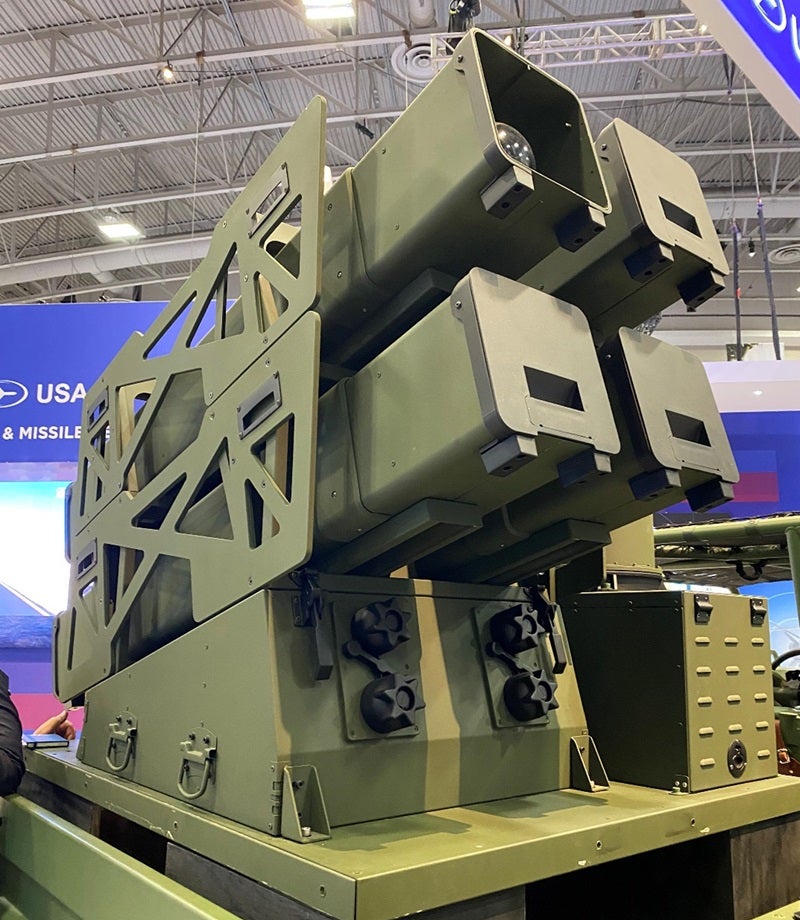
The modular, long range, and precision strike NLOS launcher can fire four of the new loitering missiles at the same time. This launcher can be mounted on the back of any vehicle that can accommodate a payload weighing up to one tonne; the integration is said to be simple enough.
The cost challenge
The European missile market has been shaken by the perpetual consumption of costly air defence missiles amid the Russia-Ukraine conflict. Yet one Estonian company, Frankenburg, emphasise the need to overcome the cost difference when using missiles to counter cheap UAS.
This has prompted Ukraine with the help of Western Europe, notably the UK under Project Octopus, to produce thousands of interceptor drones. But Frankenburg insist on the need for the faster missile capability with its own relatively lower-cost Mark 1 missile, although the company still have some way to go in this endeavour with only 53% accuracy in live firing tests.
As Rafael continue to bring two new Spike missiles to the US and global market in the near future, succeeding the 40km loitering missile, the cost challenge will need to be addressed to effectively wage a sustainable air defence effort over the longer term. Despite this backdrop, Rafael were unable to confirm the cost estimate of L-Spike 4X.
