
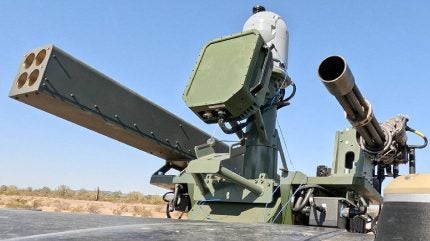
Echodyne, Moog trial counter-UAS systems during live Fort Hood exercise

Defence technology firms Echodyne and Moog have completed testing of counter-UAS systems designed to identify and engage small uncrewed aerial systems (sUAS) in battlefield conditions.
This assessment formed part of Operation Condor Rebirth, which took place at Fort Hood, Texas and evaluated integrated solutions that combined radar, artificial intelligence (AI) targeting, and weapon station controls.

Discover B2B Marketing That Performs
Combine business intelligence and editorial excellence to reach engaged professionals across 36 leading media platforms.
Find out more
During the exercise, Moog’s modular weapons platform was connected with Echodyne’s EchoShield radar, enabling interoperability with US Army turreted weapon stations through an edge computer and integration cables.
Using this arrangement, the team achieved live detection, precise tracking, and the engagement of Group 1-3 UAS threats in under three seconds.
Several organisations contributed to the demonstration. Moog supplied the Reconfigurable Integrated-weapon Platform (RIwP) and managed AI targeting, while Echodyne provided the radar hardware.
Picogrid, a partner in the exercise, supported the integration of mission systems with its Legion data platform.
This collaborative effort allowed for the deployment of AI capabilities, such as passive detection, autonomous targeting, multi-object targeting, and track re-acquisition.
The systems integrated wireless fire control and radar data, facilitating operational defence against small UAS weapons.
Throughout the scenario, organisers were able to promptly identify and address critical capability gaps on simulated battlefields.
The test results confirmed that merging precise airspace data with AI-driven firing solutions can convert existing kinetic weapon stations into effective counter-UAS (C-UAS) systems, offering a more economical approach compared to acquiring new, purpose-built solutions.
EchoShield radar contributed location accuracy across all drone types tested, with machine learning algorithms supporting target classification.
The data from the radar also enabled the targeted direction of optical sensors and timely responses from effectors, creating a foundational dataset for counter-drone activity.
Recently, Trust Automation selected Echodyne’s radar system as a primary component of its Small-Uncrewed Air Defence System (SUADS) counter-uncrewed aerial systems (C-UAS) platform, which is intended for the US Air Force.
