
Rebuilding Europe’s armoured advantage – Army Technology

Throughout Europe, the geopolitical landscape has become increasingly volatile, prompting a significant shift in military procurement strategies. The resurgence of tensions, particularly in Eastern Europe, is accelerating modernisation efforts aimed at enhancing the operational readiness and effectiveness of military land vehicles. Evolving threats, including hybrid warfare, have necessitated a re-evaluation of existing military assets, driving demand for vehicles that offer improved survivability, mobility, and interoperability.
NATO has been central to this modernisation drive. The alliance’s emphasis on standardisation ensures that military vehicles across different nations can operate seamlessly together, improving collective operational effectiveness. This standardisation is particularly crucial in the context of joint operations, where interoperability can be the difference between success and failure.
The conflict in Ukraine has further accelerated modernisation efforts, with the war highlighting vulnerabilities of outdated military equipment and a pressing need for upgrades to counter heavily armoured and mechanised formations. This includes the integration of advanced digital systems and more powerful engines to support the increased weight, and energy demands of modern military vehicles.
According to GlobalData, the global military land vehicles market – valued at US$20.8 billion in 2023 – is expected to reach a value of $31.3 billion by 2033, with cumulative spending on military land vehicles globally, anticipated to be valued at $291.5 billion over the forecast period[i]. The demand for military land vehicles is expected to be driven mainly by the European region, especially in countries such as Poland, UK, France, Germany and Turkey, which are reported to be revamping their armoured vehicle fleets[ii]. Other major military forces around the world are also currently undertaking modernisation efforts to replace their decades-old platforms to counter more modern and sophisticated threats.
What are the requirements for modern military vehicles?
Technologically, demands on military vehicles are evolving significantly, with a marked shift towards heavier platforms driven by the need for increased armour and sophisticated digital systems. These advances are essential to ensure vehicle and crew survivability amid prevalent advanced weaponry and unmanned systems, while integrated digital systems enhance situational awareness and command-and-control, enabling more effective coordination and execution of military operations.
To support these enhancements, more powerful engines are required to offset the increased weight from additional armour and equipment, delivering higher performance and reliability. This is not only an issue of operational efficiency but of strategic importance, as maintaining high mobility and speed is a critical combat advantage. The development and deployment of such advanced military vehicles are therefore pivotal to sustaining a competitive edge in modern warfare and ensuring forces are equipped for both current and future challenges.
Modern challenges in military vehicle design
Power-to-weight ratio, fuel efficiency, and reliability are critical factors that determine the effectiveness of military vehicles in operational scenarios. A high power-to-weight ratio ensures that vehicles can manoeuvre swiftly and efficiently, crucial in combat situations. Fuel efficiency extends operational range and allows vehicles to operate longer without resupply, vital in remote or hostile environments. While increased reliability ensures that vehicles cannot only remain operational under harsh and challenging conditions but also reduces downtime and maintenance costs.
The integration of hybrid and electric systems is also becoming increasingly important for future proofing military vehicles. As well as the potential to enhance fuel efficiency, they provide a quieter operation, which can be advantageous in stealth missions. The shift towards these systems reflects a broader trend in military technology towards sustainability and operational efficiency. Added to this, the increased electrical demands of modern military vehicles, driven by advanced digital systems and weaponry, necessitate robust energy management systems. Such systems are essential for ensuring that onboard systems receive adequate power without compromising vehicle performance.
The implications for vehicle design are therefore significant, as engineers must balance the need for additional electrical capacity with the constraints of vehicle weight and space, while the broader impact of engine modernisation extends beyond performance metrics. Modern engines enhance vehicle mobility and survivability by supporting advanced protection instruments such as active protection systems (APS) and explosive reactive armour (ERA). These systems are crucial for defending against modern threats like unmanned aerial systems and loitering munitions.
From an industrial and economic perspective, maintaining industrial sovereignty through domestic production is vital to retaining national control over defence capabilities and reducing dependency on foreign suppliers. Technology transfer and local manufacturing partnerships further deliver economic benefits by fostering domestic expertise and creating jobs, driving long-term economic growth and strengthening a nation’s defence industrial base.
Military vehicle propulsion advances
The mtu 199 Series engine represents a significant advancement in military vehicle propulsion technology, with the series expanding into a larger engine family. The 8V 199’s power was previously increased from 530 to 600 kW, and is now being raised to 800 kW, while the 10-cylinder 10V 199 – optimised for armoured vehicles with power requirements of up to 1,100 kW.
Recently, the German Federal Office of Bundeswehr Equipment, Information Technology and In-Service Support (BAAINBw) has commissioned Rolls-Royce Power Systems to develop the drive system for the European Main Ground Combat System (MGCS). They are developing the world’s first parallel-hybrid drive for heavy military tracked vehicles, offering an output of over 1,400 kW and features the mtu 10V 199 engine[iii].
In parallel, a 12-cylinder Series 199 engine for heavy main battle tanks and support vehicles with power requirements of 1,300 kW is evolving, set to break new ground in power and power-to-weight ratio and enabling vehicle growth potential beyond 70 tonnes[iv].
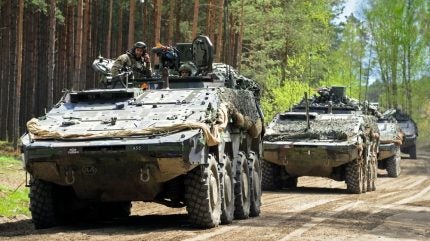
Key features of the mtu 199 Series include its exceptional power density, reliability, and modularity, all of which are crucial for military applications. Furthermore, the military-off-the-shelf (MOTS) approach taken with the 199 series also enables the creation of a resilient and scalable supply chain with the engines designed to meet NATO standardisation requirements, ensuring compatibility and logistical uniformity across allied forces. The mtu 199 Series is already widely used in European military vehicles, both in new designs and as part of retrofitting programmes for older models. In January 2026, Rolls-Royce secured orders to supply 350 mtu 199 series engines for Boxer armoured wheeled vehicles intended for the German Armed Forces and other international customers[v].
The mtu 199 Series adaptability allows it to be integrated into a variety of platforms, from lighter wheeled vehicles to heavy main battle tanks, thereby supporting a wide range of military operations across different terrains and combat scenarios. This adaptability ensures that the mtu 199 Series remains a critical component in the modernisation and operational effectiveness of European military forces in the years ahead.
For more on how mtu can help with your vehicle propulsion technologies, download the free paper below.
[i] GlobalData: The Global Military Land Vehicles Market 2023–33, May 2023.
[ii] https://www.army-technology.com/features/armoured-ambition-europe-dominates-global-military-vehicle-spending/
[iii] https://www.rolls-royce.com/media/press-releases/2026/11-03-2026-rr-and-zf-develop-drive-system-for-future-european-mgcs-tank.aspx
[iv] https://www.rolls-royce.com/media/press-releases/2025/09-09-2025-rr-significantly-expands-mtu-series-199-for-military-vehicles.aspx
[v] https://www.army-technology.com/news/rolls-royce-mtu-199-boxer-vehicles/
