

Germany consider Patriot air defence procurement with Switzerland

The German government welcomed the potential joint procurement of the coveted Patriot air defence system alongside Switzerland in a 2 October release.
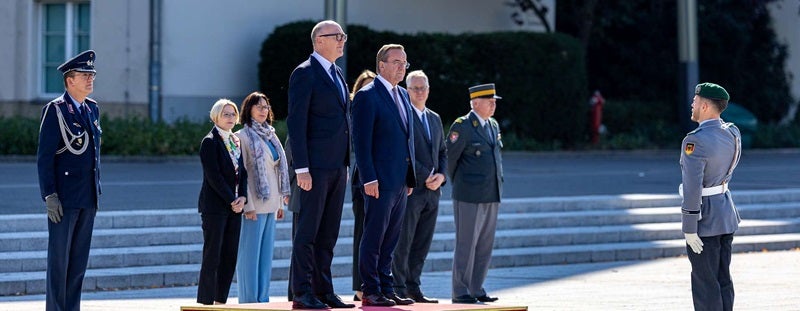
Minister of Defence Boris Pistorius welcomed his Swiss counterpart, the federal councilor Martin Pfister, to Bendlerblock in an inaugural visit. Over the next several weeks, the Bundeswehr confirmed that it will consider training Swiss troops to operate Patriot.

Discover B2B Marketing That Performs
Combine business intelligence and editorial excellence to reach engaged professionals across 36 leading media platforms.
Find out more
This plan may work well for Germany, a nation that already operates the long range system in dwindling numbers. The move would help to quickly fill the widening gaps in its domestic air defence capability.
Germany have already sent three Patriot launchers to protect Ukraine’s critical infrastructure from regular Russian strikes. In August 2025, Germany also announced that it will send further unspecified Patriot components to Ukraine within the next three months.
Yet Germany still has use for the system at home even if Ukraine is ground down in a bitter struggle to intercept Russian salvos. In fact, German Patriot systems supported Polish F-16s, Dutch F-35s, and an Italian CAEW aircraft as part of a wider Nato response to the drone strikes that entered Poland on the night of 9 to 10 September. Since then, the alliance have reinforced their posture under Eastern Sentry following the incident and other developments.
In return for shedding its air defence capability to Ukraine, an agreement had been reached with the US Department of Defense (now the Department of War) that Germany will be the first nation to receive newly produced, latest-generation Patriot systems at an accelerated pace. However, the financing will be provided by Germany, which means the country will take on a significant financial burden.
The Swiss perception
Switzerland, meanwhile, is eager to procure the American system too, having ordered five PAC-3 systems through the foreign military sales route in 2022. But in July 2025, the United States backtracked on the deal by reprioritising these systems to Ukraine instead.
The neutral country has made unprecedented steps to build its defence posture. For example, the Swiss government agreed to join the German-led European Sky Shield Initiative this time last year. In July 2025, Switzerland continued to bolster its air defence contribution by signing a joint procurement deal with Germany to purchase medium range IRIS-T SLM air defence systems. Armasuisse will acquire five systems in this deal with the German manufacturer, Diehl Defence.
Pistorius raised the opportunity for joint production, which he said would reduce the immense cost for both countries. A US government cost breakdown suggests that a single Patriot system – in all its parts – comes to around $1.1bn: $400m for the system and $690m for the missiles.
The US Congressional Research Service, citing a Nato fact sheet, stated that a Patriot ‘battery’ has six major components: a power plant [two vehicle-mounted 150 kilowatt generators], radar set, engagement control station, launcher stations, antenna mast group, and interceptor missiles (PAC-2s and PAC-3s).
Patriot ecosystem in Europe
Bayern-Chemie, a leader in propulsion for the last 60-years and a subsidiary of the pan-European defence group MBDA Deutschland, is growing in capacity and output to meet Europe’s propellant needs.
In late 2023, Army Technology learned that the company, which had been closely embedded in the production of rocket motors for American-made PAC-2 missiles during the Cold War, rejoined Raytheon’s next generation GEM-T missile supply chain with an ambition to serve as the nucleus of a new European missile hub.
“We’re building five new buildings, and we have a personnel growth in order to fulfill our contracts on time, on cost, on quality,” a spokesperson told Army Technology earlier this year.
This vision turned bleak in recent months after the United States’ withdrawal of longstanding security assets from Europe.
Worse still, this political divide has incited a trend toward European strategic autonomy. Eric Beranger, the chief executive of MBDA, said the group will deliver fully sovereign systems to European customers when required to do so. However, the company still relies on US-made components for some of its weapon systems, including the Anglo-French Storm Shadow/SCALP cruise missile.
Undeterred, the Bayern-Chemie spokesperson also confirmed that it still intends to serve as a European hub for PAC-2 propulsion systems, despite the burden of US tariffs – an alarming geopolitical development on which the subsidiary declined to comment.
